
SEO vs Paid Ads for Small Business: Which Should You Invest In First in 2026?
It's the question I get asked more than any other: "Should we focus on SEO or run paid ads?"
The honest answer is: it depends on your business, your timeline, your budget, and your goal. But most marketing agencies won't tell you that because they want to sell you both.
This blog breaks down exactly how SEO vs Paid Ads work, what each one is actually good for, what the real costs look like for Indian small businesses in 2026, and how to make the right choice for your specific situation.

First, Let's Define Both Properly
What Is SEO (Search Engine Optimisation)?
SEO is the process of making your website show up in Google search results when someone searches for what you offer without paying for the placement. When done well, SEO drives a consistent stream of high-intent visitors to your website, 24 hours a day, seven days a week, for as long as your content ranks.
The catch: SEO is a slow build. You won't see meaningful results in the first 30 days. Most businesses start seeing significant traction at the 3–6 month mark, with compounding results from 6–12 months onward.
What Are Paid Ads?
Paid ads whether Google Ads, Meta Ads (Facebook/Instagram), or LinkedIn Ads put your business in front of a defined audience immediately, in exchange for a cost-per-click or cost-per-impression. The results are fast, measurable, and completely under your control.
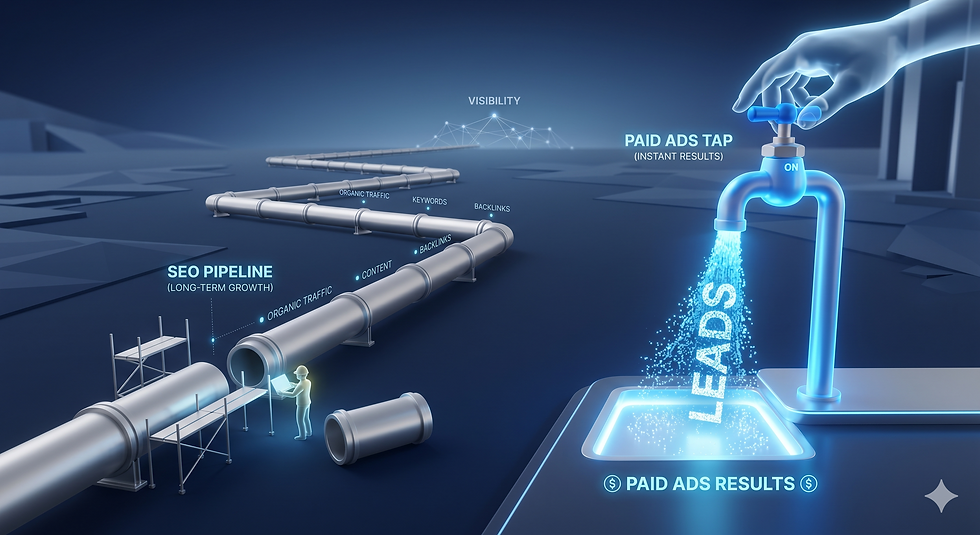
The catch: the moment you stop paying, the traffic stops. Paid ads are a tap you turn on and off. SEO is a pipeline you build over time.
SEO is planting a tree. Paid ads is buying fruit from a market. Both have value — but only one of them keeps feeding you without ongoing cost.
The Real Comparison: What Each Channel Actually Delivers
Factor | SEO | Paid Ads |
Time to first result | 3–6 months minimum | Immediate live within 24–48 hours |
Duration of results | Long-term and compounding | Stops the moment you stop spending |
Cost structure | Ongoing content + technical investment | Cost-per-click or cost-per-impression |
Best for | Building long-term authority and trust | Quick leads, promotions, testing audiences |
Trust factor | High organic results seen as more credible | Lower users know it's a paid placement |
Scalability | Scales with content quality over time | Scales with budget immediately |
Typical Indian SME budget | ₹15,000–₹40,000/month for content + technical SEO | ₹15,000–₹1,00,000+/month depending on objectives |
Skill requirement | SEO knowledge, content writing, technical fixes | Ad copywriting, audience targeting, analytics |
Risk | Algorithm changes can affect rankings | Budget exhaustion with no asset left behind |
When Paid Ads Are the Right First Move
There are specific situations where paid ads should come before SEO and if you're in one of these situations, starting with SEO first is a mistake.
1. You Need Leads This Month
If your business has an immediate cash flow need, a new product launch, or a time-sensitive offer paid ads are the only channel that can generate enquiries within days. SEO cannot help you in this timeframe.
Example: A restaurant in Pune launching a new branch needs footfall on opening weekend. Meta Ads targeting people within 5km of the location, focused on the launch offer, will drive traffic. SEO will not.
2. You Need to Validate a New Product or Service
Before investing 6 months and significant money into SEO content about a new offering, use paid ads to test whether the market actually wants it. If people click and convert you have validation. If they don't you've saved yourself a long and expensive SEO build.
3. Your Average Order Value Is High Enough to Cover Acquisition Cost
If you charge ₹50,000+ for a project, spending ₹2,000–₹5,000 per acquired lead through paid ads is a reasonable investment with strong ROI. If your average sale is ₹1,500, paid ads at that acquisition cost will destroy your margins.
4. Your Competitors Are Already Running Ads
If someone searches for your service category and the entire first half of Google is paid results from your competitors you need to be there too. Being invisible in a paid-heavy category means every high-intent search goes to a competitor.
When SEO Is the Right First Move
1. You Have a Long-Term Business
If you're not planning to shut down in the next year, SEO is almost always the right long-term investment. The compounding nature of organic traffic means that content you publish today can generate leads for 3–5 years with minimal additional cost.
2. Your Clients Research Before Buying
If your ideal client Googles questions before making a decision "best marketing agency in Pune," "how to choose a web designer," "what is content marketing" you need to be the answer to those questions. That's exactly what SEO does.
3. Your Budget Is Constrained
Paid ads require ongoing budget to generate ongoing results. If your marketing budget is limited, the compounding return from SEO will typically outperform the same amount spent on ads over a 12–18 month horizon.
4. You Want to Build Authority, Not Just Traffic
The businesses that dominate their categories online the ones your clients mention when they say "I've seen them everywhere" are the businesses that own the top organic positions for 10–15 relevant search terms. That kind of authority cannot be bought. It has to be built.
In 2026, Google increasingly rewards content that demonstrates genuine expertise and experience what it calls E-E-A-T (Experience, Expertise, Authoritativeness, Trustworthiness). For small businesses with deep industry knowledge, this is a massive opportunity to out-rank bigger competitors with bigger budgets.
A Balanced Sequence: Combining SEO vs Paid Ads for Small Business Growth
For most Indian small businesses with a limited marketing budget, here is the sequence that delivers the best long-term results:
1. Month 1–2: Fix your technical SEO foundations. Make sure your website loads fast, is mobile-optimised, and is structured correctly for Google. This costs relatively little and unlocks the benefit of everything else you do.
2. Month 1–3: Run targeted paid ads for your highest-value service or product to generate immediate leads while your SEO builds. Keep the audience narrow, the offer clear, and the budget controlled.
3. Month 2–6: Build your SEO content engine. Publish 2–4 high-quality, well-researched blogs or landing pages per month targeting the exact questions your clients search for. Every piece of content is a permanent asset.
4. Month 6+: Review paid ad performance. As organic traffic grows and you identify which SEO content converts best, shift budget away from paid for those keywords and reinvest in new acquisition channels or higher-funnel awareness ads.

What to Watch Out For With Each Channel
Paid Ads Red Flags:
• Agencies recommending Traffic objective ads when your goal is leads or sales this is the single most common wasted budget mistake in India.
• No Pixel or conversion tracking installed you're spending money with no ability to measure what's working.
• Running the same ad creative for more than 3–4 weeks without testing new versions creative fatigue kills performance.
• No remarketing strategy the majority of your budget should eventually flow towards warm audiences, not cold.
SEO Red Flags:
• Any agency that guarantees first page rankings within 30 days this is not possible through legitimate SEO and suggests black-hat tactics that will eventually penalise your site.
• Content that reads like it was written for robots, not humans stuffed with keywords, no real insight, no genuine value.
• Ignoring local SEO for Pune-based businesses, optimising your Google Business Profile and building local citations is one of the highest-ROI SEO activities available.
• No link-building strategy backlinks from credible, relevant websites remain one of the most important ranking signals in 2026.
A Simple Decision Framework
Use these three questions to decide where to start:
1. Do you need results within the next 60 days? → Start with paid ads. 2. Are you planning to be in business for the next 2+ years? → Invest in SEO in parallel. 3. Do your ideal clients search Google before buying? → SEO is non-negotiable.
Local SEO in 2026: The Biggest Opportunity for Pune Businesses
One area that's dramatically underutilised by Indian small businesses is local SEO. When someone searches "digital marketing agency Pune" or "branding agency near me" Google shows a map pack of 3 local results before any organic links. Getting into that map pack is one of the most cost-effective marketing moves available.
How to do it: claim and fully complete your Google Business Profile, collect genuine customer reviews consistently, ensure your business name, address, and phone number are identical everywhere online, and build local citations through Indian directories and chambers of commerce.
For service businesses based in Pune marketing agencies, law firms, consultants, fitness studios, restaurants local SEO can generate more qualified enquiries per rupee than almost any paid channel.
The Bottom Line
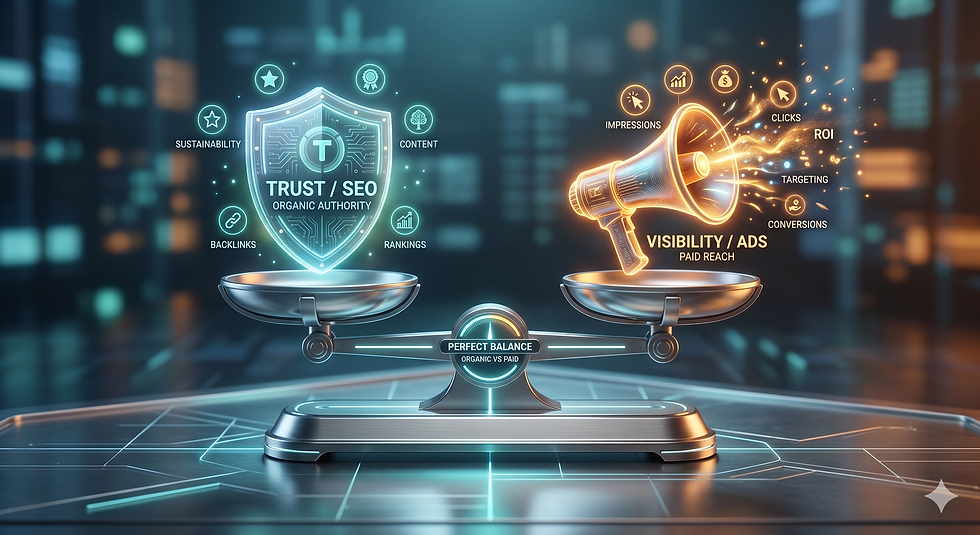
There is no universal right answer between SEO and paid ads. There is only the right answer for your business, your timeline, and your goals.
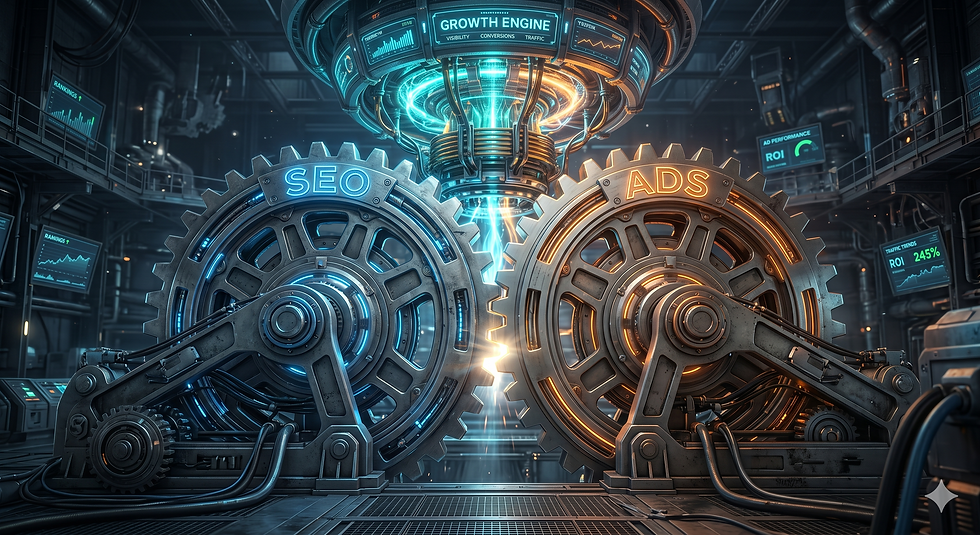
What we know for certain: businesses that invest in both over a 12-month horizon consistently outperform businesses that choose one or the other. Paid ads provide the immediate pipeline. SEO provides the long-term infrastructure. Together, they create a marketing machine that generates leads whether you're actively running campaigns or not.
The Brand Mill builds and manages both because we've seen the results when both channels work together, and we've seen the ceiling when businesses rely on just one.
Call us: 9270178082 · saakshi@thebrandmill.in · thebrandmill.in |


Comments